


Introduction
This section outlines the key legal and regulatory obligations that frame board decision making, and explains how compliance, good governance and commitment to the school’s Catholic special character must all work together to achieve excellent governance practice.
School boards in Catholic state-integrated schools operate within a legal and regulatory environment. As a Crown entity, the board must comply with New Zealand law, including the Education and Training Act 2020 and all associated regulations, its school’s Integration Agreement, the Health and Safety at Work Act 2015, and the Children’s Act 2014, alongside privacy, employment and human rights obligations.
At the same time, as part of the mission of the Church, the board is also accountable to the Bishop and Proprietor and exercises its responsibilities in a way that is consistent with Canon Law and the Catholic Church’s teaching on education, stewardship and pastoral care.
The diagram below demonstrates the partnership between the Crown, the Proprietor, and the board. It is the Integration Agreement at the centre that makes this partnership binding.
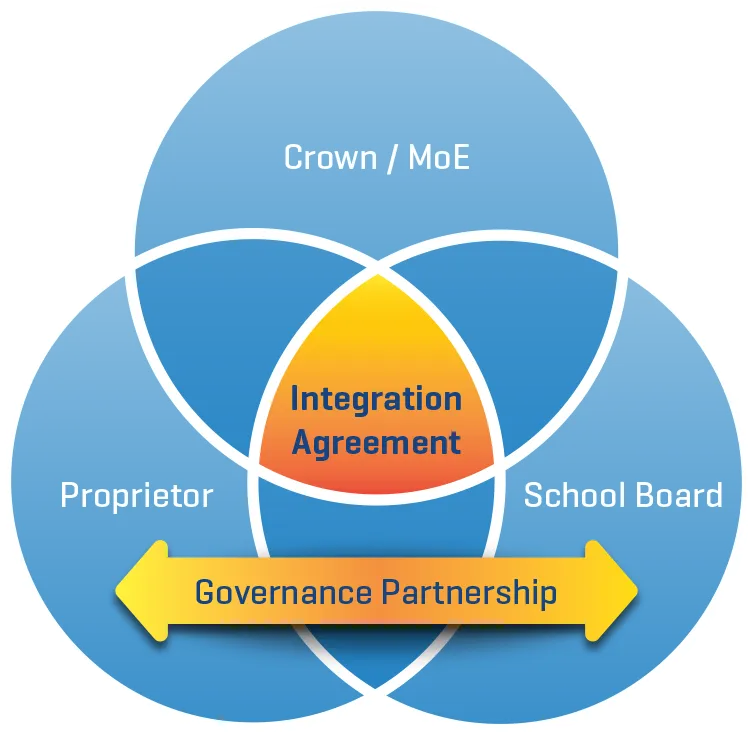
Education and Training Act 2020
Schedule 6 of the Education and Training Act 2020 is the core legal framework for state-integrated schools. It sets out what a state-integrated school is, how a private school can integrate, and the key obligations of the Integration Agreements between the Proprietor and the Crown. The agreement covers matters such as: the school’s special character and how it must be preserved; maximum roll and non-preference limits; property ownership and responsibility; boards’ obligations to accept preference students; staffing and appointments (including the role of the Proprietor in determining acceptability and the board’s responsibility to attest their legal obligations under Schedule 6 of the Education and Training Act 2020; enrolment and attendance; and the conditions under which a school can be closed, merged or have its integration agreement cancelled. Legislation New Zealand
It is critical that boards understand Schedule 6 because it defines their powers and limits in an integrated school: what they must do (for example, prioritise preference enrolments and operate within the maximum roll), what they must not do (for example, undermine special character or ignore Proprietor rights), and how they must work in partnership with the Proprietor and the Ministry.
Knowing Schedule 6 helps boards make lawful decisions on enrolment, staffing, property and finance. It protects the school from legal and funding risk and ensures that governance decisions support both the State’s requirements and the school’s Catholic special character.
Schedule 6 of the Act:
- takes precedence over other named statutes that govern the school, if there is a conflict between it and other legislation.
- guarantees the school its right to continue through its teaching and conduct to reflect education with a Special Character (Sch 6, Cl 1 (1))
- states that integration must not jeopardise the Special Character of the school (Sch 6, Cl 1(2))
- gives the Proprietor explicit rights regarding the Special Character (Sch 6, Cl 1 (3) and (4)) to:
- supervise the maintenance of the Special Character
- determine what is necessary to preserve and safeguard it
- take action if, in the Proprietor’s opinion, the Special Character is likely to be jeopardised, or is not being maintained or preserved
Integration Agreement
Each school has its own Integration Agreement. A school becomes integrated into the state education system when the Proprietor and the Minister of Education approve the school’s agreement to integrate (the Integration Agreement). This agreement establishes a partnership between the Proprietor and the Crown. This is a legally binding agreement and imposes obligations on the Proprietor and School Board. More information can be found in the Integration section of this handbook.
Canon Law
Canon law is a body of Church laws and legal principles governing the Catholic Church in its organisation and activities, and how Church members live their lives. Canon law helps the Church community to be faithful to its mission.
Those who administer Catholic schools need to keep in mind those Canons that focus on Catholic education. Some of the Canons that are relevant to the establishment of schools and the enrolment of students are paraphrased below:
- Canon 217: All those baptised into the Catholic Church have the right to a Catholic education.
- Canons 773 and 776: Parish priests must see to the formation of adults, young people and children.
- Canon 774 §2: The primary obligation for catechetical formation lies with parents. The same obligation binds godparents and those who take the place of parents.
- Canon 780: Diocesan Bishops may issue directives for catechetical formation. Catechists are to be duly trained and given opportunity for continuing formation.
- Canon 792 §2: Teachers are to collaborate closely with parents and listen to them. Parent associations are to be set up.
- Canon 797: Parents must have freedom to exercise choice in determining which school their children will attend.
- Canon 798: Parents are to send their children to those schools that will provide for their Catholic education. If they cannot do this, they are bound to ensure the proper education of their children outside the school.
- Canon 800 §2: Catholic schools are to be promoted and everything possible done must be done to help establish and maintain them.
- Canon 802 §1: Where there is no Catholic school, one must be established.
- Canon. 804 §1. The Catholic religious instruction and education which are imparted in any schools whatsoever or are provided through the various instruments of social communication are subject to the authority of the Church. It is for the conference of bishops to issue general norms about this field of action and for the diocesan bishop to regulate and watch over it.
- Canon 805: The diocesan Bishop has the right to appoint or approve teachers of religion and to remove them or demand that they be removed, if religious or moral considerations require.
- Canon 806 §1: The diocesan Bishop has the right to watch over and inspect the Catholic schools in his diocese and to issue directives concerning the general regulation of Catholic schools.
- Canon 806 §2: Catholic schools are to ensure that the academic standards of the formation given in them is at least as good as that in other schools.
Other relevant legislation
Children’s Act 2014
The board is responsible for ensuring that all employees and contractors are safe and competent to work with children. From 1 July 2015 the Act placed increased responsibilities on to boards to protect students.
The Act affects all schools equally; there are no special responsibilities that relate to integrated schools. Proprietors, however, are expected to take particular interest in how well Catholic schools meet these responsibilities, in the values they promote and in their practices.
How it applies to boards
- Requires safety checking of children’s workers (including many school staff, contractors and some volunteers) in government-funded organisations, with checks updated at least every 3 years. More information can be found here.
- Introduces workforce restrictions – it is unlawful to employ or engage a core children’s worker with certain specified offences unless they have a core worker exemption. More information can be found here.
The Act requires increased safety checking of prospective staff, consisting of:
- Confirmation of the employee’s identity by the school
- Police vetting of all staff (not only teachers) and of any other person likely to have unsupervised access to children during normal school hours (e.g., contractors and the staff of other agencies)
- risk assessment by the school, based on interviews and referee checks.
Board responsibilities
- Ensure the school has robust child protection and safety-checking policies and procedures, including police vetting plus the other required components of a safety check. More information can be found here. And also here Education.govt.nz
- Monitor compliance (for staff, regular relief teachers, contractors and volunteers who are children’s workers).
- Make sure the board does not approve appointments that breach workforce restrictions.
Health and Safety at Work Act 2015 (HSWA)
How it applies to boards
- HSWA is New Zealand’s primary work health and safety law and applies to almost all workplaces. WorkSafe
- The school board is the PCBU (person conducting a business or undertaking) and must ensure, so far as is reasonably practicable, the health and safety of workers and others (students, visitors, contractors) at school. More information can be found here.
- Board members are also “officers” and owe a due-diligence duty to exercise governance oversight of health and safety, even though individual board members are protected from prosecution for certain HSWA offences. More information can be found here.
Board responsibilities
- Provide visible health and safety leadership, set expectations and monitor performance.
- Ensure there is a fit-for-purpose HSW policy and risk management system (hazard identification, risk controls, incident reporting, contractor management, student activities, EOTC, etc.). More information can be found here.
- Receive regular reporting and evidence that risks are being identified, controlled and reviewed.
Privacy Act 2020
How it applies to boards
- Sets 13 Information Privacy Principles governing how agencies collect, store, use and share personal information.
- Applies to all schools and boards; each school must appoint a Privacy Officer.
Board responsibilities
- Approve and periodically review a privacy policy that covers enrolment, student records, pastoral notes, health information, CCTV, online platforms, and information sharing with agencies. Education.govt.nz.
- Ensure procedures comply with the principles (lawful purpose, data minimisation, security safeguards, access and correction rights, limits on disclosure).
- Confirm staff receive training on privacy principles and that the school can respond properly to access and correction requests and privacy breaches.
Public Service Act 2020 (as it applies to Crown entities)
How it applies to boards
- Provides the overarching framework for the Public Service, with the Public Service Commissioner leading integrity, accountability and transparency across State services.
- Through the Crown Entities Act (which applies to school boards as Crown entities), boards are expected to uphold public service principles and values – acting lawfully, impartially, fairly and in the public interest. More information can be found here.
Board responsibilities
- Lead a culture of integrity, impartiality and stewardship of public resources, consistent with public service principles.
- Ensure board conduct, conflicts-of-interest management, and decision making meet the standards expected of Crown entities (including transparency and accountability to the Minister and community).
Human Rights Act 1993
How it applies to boards
- Makes it unlawful to discriminate on specified grounds (e.g. sex, race, disability, religious belief, family status) in key areas of life, including employment and education.
- Prohibits discriminatory questions and practices in recruitment and employment. Employment New Zealand
Board responsibilities
- Ensure policies and practices around enrolment, discipline, learning support and access to activities do not unlawfully discriminate, while also working within Schedule 6 and the school’s Integration Agreement (e.g. lawful preference for Catholic students, special character staff positions).
- Oversee fair employment practices (recruitment, promotion, dismissal, workplace culture) that respect human rights and align with Catholic social teaching.
- Be aware of how human rights and anti-discrimination obligations intersect with special character requirements for certain roles and enrolments.
Health and Safety
Student and staff health and safety
Health and safety are concerns common to all schools. The Ministry of Education and the
NZ School Boards Association have both issued comprehensive guides to this Act.
This section focuses on the features and requirements that specifically affect state integrated schools.
Requirements for Proprietors
For state-integrated schools the major difference is in the shared responsibility for health and safety resulting from the Proprietor’s ownership of the land and buildings. Proprietors have to ensure that their buildings and grounds are constructed and
maintained to a standard that is safe for all who work at or visit the school premises.
Requirements for Boards
Under the Health and Safety at Work Act 2015 the board has the prime duty of care to ensure that:
- the school is safe for all who work there or visit
- actual and potential risks are identified
- all practical steps are taken to eliminate, isolate or minimise them.
The board should have a comprehensive health and safety policy, ensure that it is implemented in the school, and monitor its effectiveness. The Act emphasises the collective nature of responsibility for health and safety.
Under the Act, the board’s responsibility is broadened to keep safe all people who are at or visit the school. The Act puts greater emphasis on:
- staff and student participation and engagement with health and safety
- active consultation and collaboration with other organisations such as
construction companies to ensure a cooperative approach to health and safety at the school, or at school events beyond the school.
Shared responsibilities at state-integrated schools
As in a state school, the board of a state-integrated school has the prime duty of care for health and safety at the school. Since the Proprietors own the integrated buildings and grounds, they are responsible for health and safety on the school premises in relation to:
- capital works projects undertaken by the Proprietor that involve construction and
maintenance - the safe condition of the Proprietor’s buildings, grounds and associated plant.
The Ministry’s comprehensive practical guide to the Act is available on their website.
Board’s responsibilities
The board is required to monitor health and safety at the school premises. The principal and staff are in the best position to identify risks to health and safety, both day to day and through periodic inspections. When these risks result from unsafe buildings and other fixtures, the principal should act immediately to remedy this by commissioning repairs under the school’s minor maintenance policy or alerting the Proprietor to the need for remedial capital works, as appropriate. However, the principal must take all reasonable steps to ensure the safety of all on the school premises while the school awaits action by the Proprietor. The board should ensure that its health and safety policy provides appropriate guidance and delegation to the principal for such situations.
When the Proprietor commissions capital works on integrated premises, the board or the principal must at an early stage coordinate health and safety measures with the Proprietor and with the contractors carrying out the works. The principal should ensure good overall safety standards on the school premises during the works. There should be close collaboration between the respective 10-year maintenance plans of the board and the Proprietor, with an emphasis on health and safety. The Ministry of Education’s Policy One funding of the Proprietor’s capital works must be prioritised for health and safety matters.
Board members are encouraged to walk around the school every few months to ensure that they understand the level of safety and risk management that the school is carrying out in the board’s name.
Proprietor’s responsibilities
The Proprietor is responsible for maintaining the integrated buildings to the required code. It is also the Proprietor’s responsibility to ensure that any Proprietor commissioned works on school premises are carried out safely.
This means that when commissioning and carrying out capital works the Proprietor must coordinate health and safety measures with the board or the principal. Likewise, it is the Proprietor’s responsibility to require the contractors that carry out the works to coordinate their actions with the school and to monitor the safety practices of their contractors.