


Introduction
Property is a shared responsibility in state-integrated schools. While the Proprietor owns the land and buildings, the school board is responsible for day-to-day care and use of the school premises, supported by Crown funding. Clear understanding of ownership, funding streams, and decision-making boundaries is essential to avoid misunderstandings and ensure the property remains safe, fit-for-purpose, and compliant.
The requirements of integrated schools differ from those of state schools as follows:
- legislative and regulatory requirements for ownership and property standards as laid down in Schedule 6 of the Education and Training Act and the school’s Integration Agreement, which can be found here.
- the maintenance of buildings and grounds – funding minor and major maintenance
- new buildings – the funding of expansion and new schools
- furniture and equipment – funding and maintenance
- insurance – responsibility for this is shared by the proprietor and the school board
- other use of the school premises.
Property Obligations
Legal requirements and Integration Agreement
The property obligations of the Proprietor and the Crown are set out in Schedule 6 Cl 39 to 42 of the Education and Training Act 2020, and in each school’s Integration Agreement.
Minimum property standards for state-integrated schools
Under Schedule 6, Cl 39(2) of the Education and Training Act, property covered by an Integration Agreement must meet minimum standards to ensure that it is safe, in a fit state of repair, and meets all statutory, regulatory and Ministry of Education design standards.
When a school becomes state integrated, the Ministry may identify work required to bring the land and buildings up to minimum state standards. This work will be listed in the Third Schedule of the school’s Integration Agreement.
After integration the Ministry may also ask the Proprietor to do other work to maintain minimum standards.
At a minimum, the Proprietor and the Board must be sure that:
- buildings with specified systems have a current Building Warrant of Fitness (BWOF)
- the school has a process for managing health and safety issues
The Board is responsible for identifying, eliminating, isolating and/or minimising risks to health and safety on the premises. The Proprietor is responsible for capital work to remedy identified and agreed risks.
- an appropriate professional consultant, such as an engineer or architect, designs and certifies all structural additions and alterations
- the school board has a long-term maintenance plan and implements it effectively in collaboration with the Proprietor. (For more information, visit the Ministry Property website )
- all aspects of the school’s property portfolio are compliant with the Health and Safety at Work Act 2015.
Ownership of land and buildings
The Proprietor is the owner of all the land, buildings and other improvements described in the school’s Integration Agreement and any supplementary agreements. The school site plan (which is attached to the school’s Integration Agreement) shows the school’s premises, clearly distinguishing the land and buildings that are integrated from those that are not. The Proprietor meets liens, mortgages and other charges (such as insurance) associated with the land and buildings that comprise the school premises.
The proprietor gives the school board (the school’s controlling authority) exclusive right to the use of the school premises, including buildings and chattels.
Unless other arrangements are made with the school board, the proprietor is responsible for any costs associated with the non-integrated areas (such as a chapel or hostel). The proprietor may allow the school to use such facilities and may require the school board to pay for their use by way of an agreed rental or other usage contribution. (This can be agreed via a MOU).
Any building on the Proprietor’s land belongs legally to the proprietor unless, by consent of the proprietor, it is vested in the school board. An amendment to the Integration Agreement between the Minister of Education and the Proprietor will be required before the School Board has exclusive use of a new building that is part of the school’s integrated portfolio.
The school board may construct a building or other facility on the school premises using its own (Crown) funds, and own this, but only with the prior agreement of the Proprietor and the Ministry of Education. If agreed to, a Memorandum of Understanding is required between the Proprietor and the Board to ensure that ownership and maintenance of any building that has been constructed with any input of Board (Crown) funds, or funds from other sources (such as the school’s Parent, Teacher and Friends Association), are clearly delineated.
Alteration of School Premises
A school board cannot add to the school premises, dispose of any part of the school premises, or otherwise alter its boundaries or dimensions. If a school board considers any of these desirable, it is required to approach the Proprietor with a proposal to that effect. To be implemented, such changes require a Supplementary Agreement between the Proprietor and the Minister of Education.
Maintenance of buildings and grounds
The Board’s 10-year property maintenance plan
The board is responsible for all expected maintenance of buildings and fixtures within a 10-year period. The board is obliged to have a 10-year property maintenance plan and to set aside an adequate budget to cover maintenance when it becomes due.
The repair (such as painting, fixing broken equipment, and minor repairs to buildings and infrastructure) of damage to buildings caused by reasonable wear and tear, or carelessness is also a cost to the board and is covered by the school’s maintenance funding. It cannot be claimed through the Proprietor’s insurance.
The Ministry’s website provides further information for school boards about items eligible for maintenance funding.
 Ministry of Education’s responsibility for funding
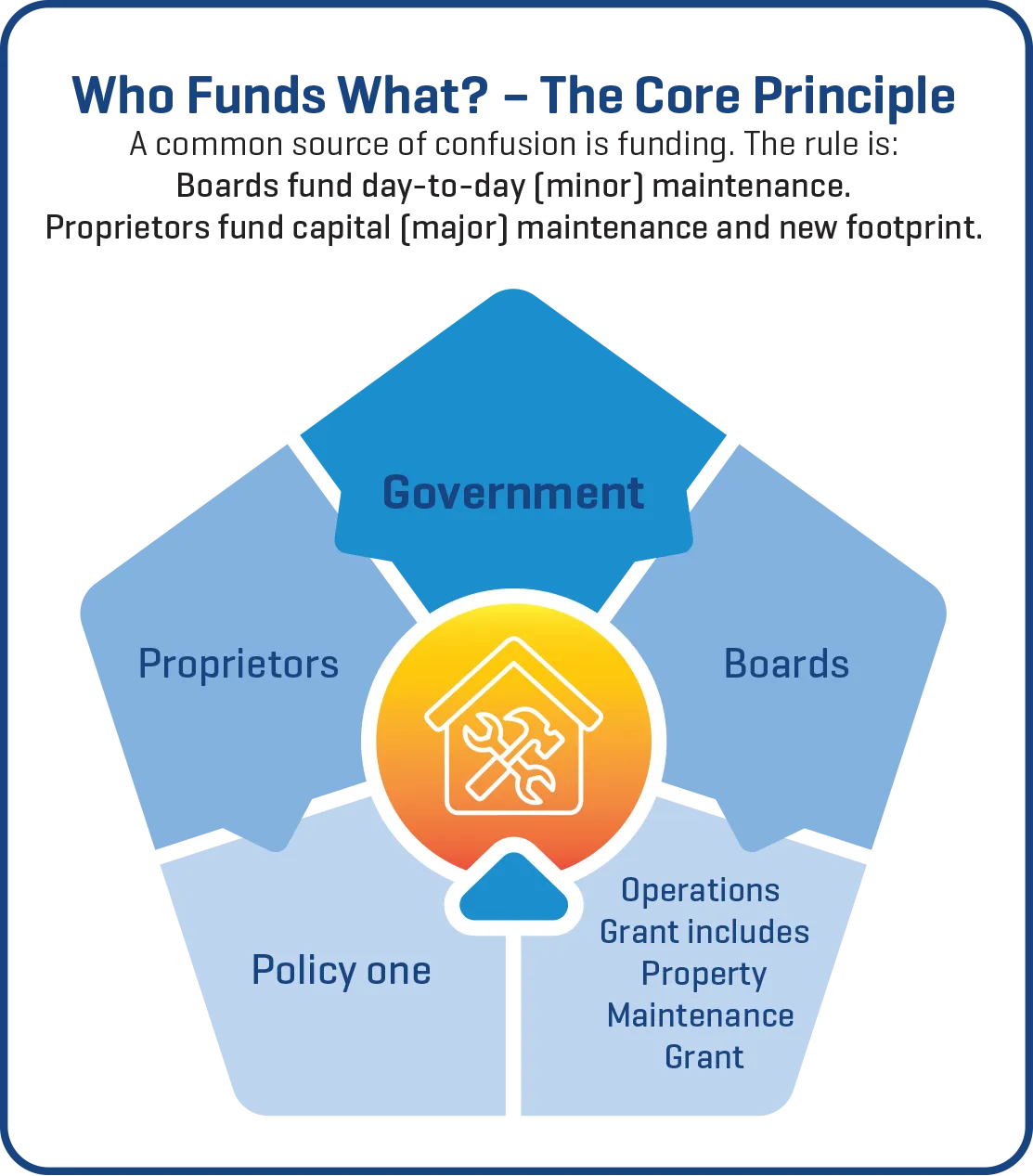
The Proprietor owns the school’s land and buildings; the Ministry of Education provides the funding for integrated buildings maintenance through two categories: minor maintenance and major (or capital) maintenance. It also provides funding for furniture and equipment, and for insuring these.
Funding of minor maintenance – School Board Responsibilities
The School Board is responsible for minor maintenance of integrated property. This is funded by the Ministry through the school’s operational grant, which includes a Property Maintenance Grant.
The amount is based on the amount of integrated property, up to the maximum gross square meters entitlement as calculated by the School Property Guide (SPG). You can view the details of your annual Property Maintenance Grant on the Ministry of Education Property Portal.
Each year the Ministry sends the school board an indicative and a confirmed Grant Advice Notice giving details of the school’s property maintenance funding for the year. This funding is paid directly into the school’s bank account in quarterly instalments
The school board’s legal responsibilities for maintenance are confined to the integrated areas.
Minor maintenance includes:
- routine repairs,
- cyclical maintenance painting (even when costs exceed $5,000),
- maintenance of buildings, grounds, furniture and equipment,
- damage caused by wear and tear, fixing broken equipment, repairing a broken water pipe.
- Please note:This figure of $5,000 value is not an absolute guideline for maintenance – Boards, for example, are required to make provision for the painting of all school buildings on a regular cycle. Painting is the largest maintenance cost a board faces and can range from $10,000 to $70,000, depending on the size of the school. Painting associated with remodelling or modernisation capital works within the footprint of existing buildings is also the board’s responsibility.
Key points:
- There is a $5,000 threshold guideline, not a hard rule.
- School boards must maintain a 10-year property maintenance plan and budget accordingly.
- School boards cannot make structural changes without the Proprietor’s written approval.
Funding of major (or capital) maintenance and modernisation – Proprietor
The Proprietor is required to keep the school’s integrated school property up to the standard of equivalent state schools.
The Proprietor is responsible for major maintenance, modernisation, and capital works that:
- cost more than $5,000 (excluding GST),
- replace or significantly improve an existing asset,
- are required to meet statutory or safety standards.
Policy One Funding
- The Ministry of Education provides Policy One funding to Proprietors.
- It is calculated on a per-student basis, paid quarterly, and must be used on integrated property only.
- Funding may be pooled across schools within a Diocese or cooperative.
Policy One funding:
- must be prioritised for urgent health and safety work and essential infrastructure work and also covers:.
- roofs, boilers, fire systems,
- any property modifications needed for students or staff with special needs
- structural alterations,
- major emergency works (not covered by insurance),
- modernisation projects.
2010 Policy One Guidelines document sets out how the funding should be spent by Proprietors of integrated schools and the processes for managing this expenditure. Also visit the MOE website here.
Capital works or routine maintenance?
The Ministry of Education states that when deciding if a task is capital works or routine maintenance, it is useful to assess the volume or extent of the change required. For example, if a few sheets of iron on the roof need replacing, this is routine maintenance. However, if most of the iron needs to be replaced (so that, in effect, the building needs a whole new roof), this is capital replacement.
In small schools that receive relatively little funding for minor maintenance it may be necessary for the Proprietor to pay for works that cost less than $5,000, particularly if these works improve the capital value of the property.
The Proprietor has discretion in how far to support Boards that are faced with major maintenance expenses, as happens from time to time. This applies to very small schools in particular.
Funding through Attendance Dues and Voluntary Donations
Parents/caregivers are legally required by law to pay Attendance Dues to the Proprietor. Annual Attendance Dues for each state integrated school are capped at a maximum level by the Crown. The uses of attendance dues are set out in legislation (Source: Sch 6 Cl 30).
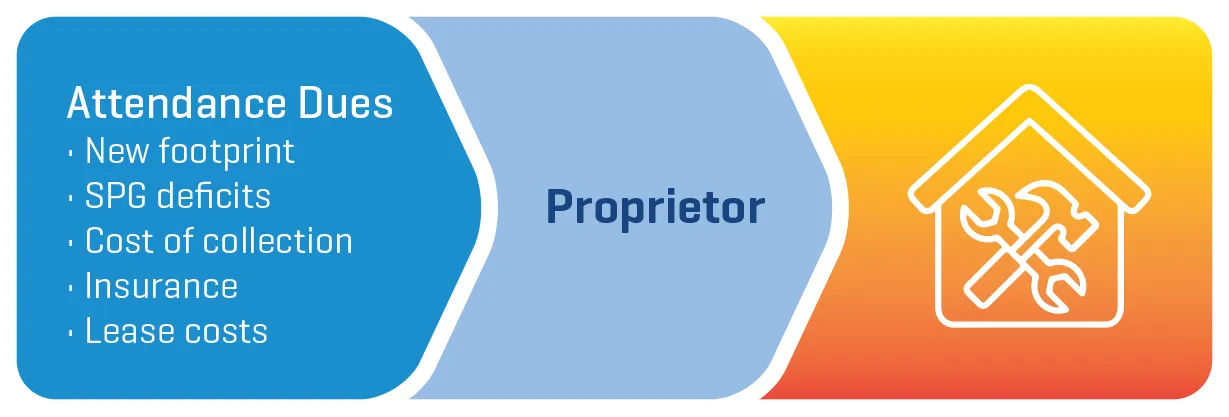 Attendance Dues may be used for:
- new building footprint (additional space),
- SPG (School Property Guide) deficits,
- insurance and lease costs,
- cost of collection.
Attendance Dues cannot be used for:
- staffing,
- replacement or renewal of existing building footprint,
- building beyond SPG entitlement,
- professional development.
Voluntary donations may also be made to the Proprietor to support:
- property not covered by integration,
- special character such as chapel.
Attendance Dues are capped by the Crown and any increase must be approved and re-gazetted.
New buildings
Proprietor’s responsibility for new buildings
A school may require new buildings or other additional accommodation because of changes in the state school minimum accommodation code, roll growth within SPG entitlement, or approved maximum roll increases. Such additions are the responsibility of the Proprietor. The Crown may sometimes assist through Policy Two capital funding.
School board’s responsibility to inform proprietor
Structural changes to buildings or grounds
The school board has no authority to make structural changes to the buildings or grounds (such as putting up or removing a dividing wall or constructing a changing shed or relocatable classroom) without first consulting the Proprietor’s Property Office and obtaining the Proprietor’s written authorisation.
The school board is required to bring to the Proprietor’s attention any maintenance items that are in the major category. The Board and the Proprietor are obliged to coordinate their respective 10-year maintenance plans to ensure that the best use is made of the two streams of maintenance funding.
Proprietor’s 10-year property plan
The Proprietor (or their professionally accredited agent) undertakes, year by year, a plan of work that covers the works the Proprietor is obliged to implement.
The Proprietor’s Property Office in each diocese (or individual Proprietors, in the case of schools owned by religious orders outside of diocesan cooperatives) prepares a rolling 10-year property plan in which it prioritises and plans those works as funds allow. It is important that the Proprietor’s Property Office (or the Proprietor’s agent) consults with the Board on these matters, and that the two parties coordinate their respective (major and minor) 10-year maintenance plans.
Comprehensive information related to the management of property in integrated schools is found here
Consequential effects for maintenance funding
As soon as any capital works are completed, the Proprietor or the Proprietor’s agent completes a site plan update and lodges it with NZCEO. The site plan update is logged and then sent to the Ministry for review and agreement. The site plan is placed on the Ministry of Education’s property system, which is a computerised record of all the assets (including buildings and land) held by every state and state-integrated school. This updated information will ensure that the school’s operational funding for maintenance is adjusted to allow for the upkeep of the new accommodation. Not all asset plan updates are for new footprint. Some are major alterations of existing buildings or rationalisation.
School boards can access their details on the Ministry’s website and check whether they are receiving the correct amount of property maintenance funding for their integrated school property portfolio.
Comprehensive information related to the management of property in integrated schools is found here
Board-funded buildings
The board of a state-integrated school is a Crown entity. As legal entities, Boards have the status of body corporates as established and constituted under the Education Act 1989 (as affirmed in the Education and Training Act 2020). This means that they can own land, enter contracts, and so on. As Crown entities (defined under Section 7 of the Crown Entities Act 2004) they are subject to rules about what they can and cannot do without obtaining approval from the Minister of Education, such as lend or borrow and enter certain investments.
Key points are:
Ownership and Funding Rules
- Crown funds (including school board-raised funds) cannot be used for buildings that will legally belong to the Proprietor.
- Any building on Proprietor-owned land belongs to the Proprietor unless vested in the school board by consent which requires an amendment to the Integration Agreement between the Minister of Education and the Proprietor. This will be required before the Board has exclusive use of the new building.
- Buildings funded by Crown monies will not be integrated. School boards must cover ongoing maintenance and insurance.
- Proprietors may refuse permission for unintegrated buildings on their land.
- Jointly funded buildings are possible but rarely approved.
- A Memorandum of Understanding is required for any building involving school board funds to clarify ownership and maintenance responsibilities.
Board-funded capital works
Boards may wish to undertake major capital improvements to the school buildings or grounds, using Crown funds.
If the school needs major capital work just to meet the required Ministry of Education building standards (the “code entitlement”), that work is the responsibility of the proprietor, not the board.
The board may only fund major capital projects when the project goes beyond what the Ministry requires as the minimum standard.
These are optional enhancements, not basic compliance work.
Key points are:
- School board-funded capital works are allowed only for facilities beyond code entitlement. Upgrading to code is the Proprietor’s responsibility.
- School board are advised to engage the proprietor at an early stage and must obtain written approval from both the Proprietor and the Ministry of Education before planning or financing projects.
- Local authority building consent and, if needed, resource management consent are also required.
Planning and approval for School Board-funded improvements
It would be most unwise to begin planning or financing major projects without the written permission of both the Proprietor and the Ministry of Education. All the relevant issues need to be clarified first – for example, estimated costs; who will be responsible for what aspect of the work; who will be responsible for insurance and maintenance; whether the Ministry of Education will supply furniture and equipment; whether the project will affect any covenant or mortgage on the land; whether it meets the Ministry of Education’s health and safety requirements; whether the addition or alteration is permanent or temporary and, if so, how long it will be in place.
If a capital work is executed without fulfilling all the Ministry of Education’s requirements, particularly those related to health and safety, the Ministry may prevent the school from using the new facility until the requirements have been completed at the school board’s expense.
If a capital work is executed without the Proprietor’s authority, the Proprietor may require a reversal of the work at the School Board’s expense.
Maintenance of Board-owned property
School boards are required to use their own funding (which can include money from fundraising or the use of surplus operational funding) to pay for the maintenance of property that has been paid for with:
- the school board’s funding (from the Crown), or
- funding provided by the community.
School Board-Funded Buildings and Capital Works – Summary Table
| Topic | Key Points for School Boards |
|---|---|
| Legal Status | Boards are Crown entities and body corporates under the Education Act 1989. They can own land and enter contracts but must comply with Crown Entities Act restrictions (e.g., borrowing requires Ministerial approval). |
| Ownership Rules | – Crown funds cannot be used for buildings that will legally belong to the Proprietor. – Any building on Proprietor land belongs to the Proprietor unless vested by consent and Integration Agreement amendment. – Buildings funded by Crown monies will not be integrated; School Board covers maintenance and insurance. |
| Permissions Required | – Proprietor may refuse permission for unintegrated buildings. – Joint funding with Proprietor is possible but rarely approved. – Memorandum of Understanding required for any building involving School Board funds. |
| Capital Works Conditions | – Allowed only for facilities beyond code entitlement. – Must have written approval from Proprietor and Ministry of Education before planning or financing. – Local authority building consent and resource management consent may be required. |
| Planning Checklist | Clarify: estimated costs, insurance and maintenance responsibilities, furniture supply, impact on land covenants/mortgages, health and safety compliance, permanence of addition. |
| Risks | – If Ministry requirements unmet, facility may be unusable until corrected at School Board’s expense. – If Proprietor approval not obtained, Proprietor may require reversal at School Board’s expense. |
| Maintenance | School Boards must use their own funds (including fundraising or surplus operational funding) to maintain property paid for with Board or community funds. |
Furniture and equipment
Ministry of Education funding of furniture and equipment
The Ministry provides school boards of state-integrated schools with an annual grant to replace and modernise existing furniture and equipment. This funding is paid to boards on 1 July each year. The annual furniture and equipment grant is calculated as a fixed percentage of up to 5% of the Proprietor’s Policy One funding. The percentage amount depends on the type of school.
The Ministry also provides boards with a one off furniture and equipment grant for new teaching spaces at state-integrated schools, as appropriate for the room’s intended use. The funding for new teaching spaces is based on net square metres (this does not include corridors, circulation space, toilets, etc.) up to its School Property Guide (SPG) entitlement. The proprietor makes the claim, and the Ministry pays the funding to the school board.
School board’s responsibility for furniture and equipment
The school board purchases and becomes the owner of the furniture and equipment, and is responsible for insuring it. The purchase must be recorded in the school’s accounting system and its property register. The school board is also responsible for the routine maintenance of furniture and equipment.
Insurance
Responsibility for insurance is split between the proprietor and the school board, and possibly others who use the school. It is wise for the board to consult with the proprietor to make sure that the cover is adequate and, if it appears advantageous, to have one cover for all risks. In most dioceses the Proprietors’ Property Office can arrange a comprehensive cover that shares the costs.
Because insurance can be complex, school boards should seek information and advice on particular matters from the insurance brokers retained by Proprietors’ offices (Diocesan Education Offices, Diocesan Property Offices or the Proprietor’s agent) or from individual proprietors insurance officer.
Proprietor’s responsibility for insurance
The Proprietor is obliged to insure the buildings against fire, earthquake, storm, flood, burglary, arson, vandalism and malicious acts. In this context ‘buildings’ includes any item fixed to the buildings or grounds (e.g., toilet pans, doors and fixed shelving). It does not include tractors, computers, library books and so on, which are classified as contents.
Damage to buildings caused by reasonable wear and tear, and carelessness cannot be claimed on the Proprietor’s insurance. It is covered by minor maintenance, which is a cost to the Board.
There may be items that are, in effect, contents but are lent to the school by the Proprietor (including items listed as such in a schedule to some Integration Agreements) or are stored in the school but not owned by it (such as equipment belonging to an associated sports club). In these cases it is the responsibility of the Proprietor or other owner of these items to make sure that they are insured.
School Board responsibility for insurance
The school board is responsible for insuring school contents, any items that meet the definition of furniture and equipment and which are on the board’s register of assets. Contents insurance is met from operational funding.
The school board is responsible for other insurance (such as public or third-party liability, loss of cash and fidelity guarantee) and for insuring any board-owned buildings, if any.
Access and use of school premises
Access by the proprietor
The Integration Agreement gives the Proprietor or the Proprietor’s agents (including the parish priest, the Education Manager, and Religious Education Advisers) access to the school after giving reasonable notice, at any reasonable time to ensure that the special character is being maintained or to ensure that the asset has not deteriorated through lack of maintenance.
Normally the Proprietor’s agents would first contact the principal to make sure that by exercising this right they do not disrupt the school. The relationship between agents of the Board and agents of the Proprietor should be one of cooperation and good faith.
If the Proprietor’s appointees on the school board have cause for concern, the matter should be raised with the Proprietor’s Property Office, the Proprietor’s agent in the diocese, or the Proprietor’s Trust Board, as appropriate. In any case, the Proprietor’s appointees on the school board are required to report on the state of repair of the integrated and non-integrated buildings and grounds when they make their annual report to the Proprietor.
Areas of shared access between the school board and the proprietor need to be regularised by means of a written agreement between the parties. This normally is in the form of a Memorandum of Understanding.
Other users of school premises
The Proprietor grants the use of the school premises to the school board, subject to conditions set out in the Integration Agreement. These conditions include the following.
If the Proprietor asks the school board to make all or part of the school premises or equipment available to the Proprietor or other persons, the school board may not withhold consent without a good reason to do so. Examples may include using classrooms for parish meetings, using the school hall for church functions and parking in the school grounds during Sunday Mass. The user should pay the school board enough to recover any costs (such as heating and lighting) and make good any damage caused.
The school board may also lend or hire its facilities to other users but must have the consent of the Proprietor, who may not withhold that consent without good reason – for example, if there was danger of damage to the asset or if the proposed use was unsuitable for diocesan-owned schools.
Working Together and Effective Relationships
Property matters require a practical and cooperative relationship between the Board and the Proprietor, underpinned by a shared understanding of funding responsibilities and decision-making authority. Working effectively together involves early consultation, transparent planning, and realistic timeframes, particularly where property issues impact teaching and learning. Strong relationships help manage expectations, resolve pressure points constructively, and ensure property decisions support the long-term sustainability of the school.
Resources and Appendices
Policy One funding for capital work at integrated schools
The Ministry provides proprietors of state-integrated schools with funding to modernise and upgrade their integrated school property. Known as Policy One funding, it fulfils a similar purpose to the 5 Year Agreement (5YA) funding the Ministry provides to state schools.
View more information about using policy one funding for capital works here.
Policy One Guidelines
These guidelines set out how Policy One funding should be spent by Proprietors of integrated schools and the processes for managing this expenditure and can be found here.
Furniture and Equipment Funding Guidelines
State integrated schools are eligible for furniture and equipment funding for modernisation projects, and new square metres projects (which are planned projects to create additional accommodation).
These guidelines explain the entitlement for furniture and equipment funding calculation, and the process for claiming funding. Click here to download PDF.
Property Maintenance
This guidance provides tips for property maintenance, working with a caretaker, and hiring contractors for technical maintenance. Click here to view the MOE Property Maintenance Guide.